Melbourne Airport
Terminal 3, Stage 2 Redevelopment
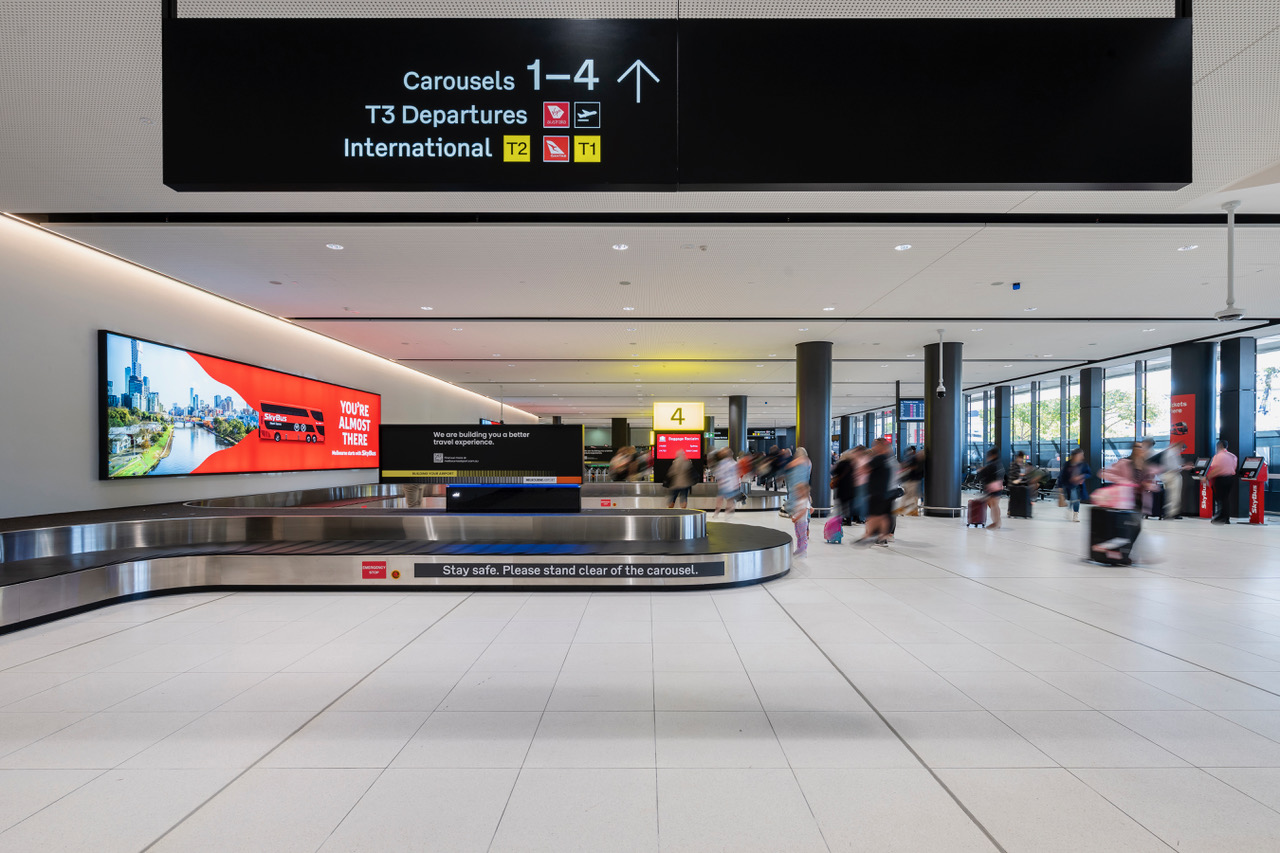
Melbourne Airport’s (MA) Terminal 3, Stage 2 Redevelopment Project has expanded the arrivals infrastructure, enabling the terminal to operate on a world-class scale, attain back-of-house operational excellence and enhance passenger experience, whilst also providing opportunities for MA to generate revenue from increased retail offerings and plan for future business growth.
Project overview
The project includes a new, larger arrivals hall, was strategically staged to manage the inherent complexities of high-profile, high-risk projects.
Delivered in partnership with Virgin Australia (VA) and Melbourne Airport, the project has enhanced the passenger arrivals experience with a larger arrivals hall, additional baggage carousels, increased retail offerings, improved vertical transport and anti-pass back exits and a terminal forecourt upgrade.
The works included:
- New integrated Arrivals Hall, seamlessly linking Terminal 3 Arrivals Hall with Terminal 4
- Installation of 4 new reclaim belts, reconfiguration of 2 existing reclaim belts, and lengthening the belt size at baggage reclaim
- Demolition of the existing Arrivals escalators
- Installation of a new anti-pass back
- Construction of a 4-level fire egress stairwell inside the arrivals hall
- Provision of a secure integrated communications and services rooms for airport operations
- Expanded retail offerings on ground and mezzanine level
- Replacement of the VA club cladding and installation of a new air handling unit on the Terminal 3 roof, which serviced the VA lounge
- A new VA staff locker room and amenities
- Upgrade of the Terminal 3 forecourt, and coordination of the Skybus commuters to Terminal 3.
Our role
RP Infrastructure (RPI) provided design management during the front-end planning phase, and project management and contract administration services during the procurement and delivery stages.
RPI proactively mitigated interfacing risks through collaboration with the Contractor and the APAM Interface Manager to ensure public safety and enable construction works to continue.
Extensive planning and documentation were critical in the lead-up to handover, including engagement of all relevant APAM stakeholders and completion of all operating procedure documentation. RPI facilitated meetings, inspections and signoffs, and approval with the Airport Control Building authority in conjunction with the Contractor.
RPI was responsible for the dissemination of monthly project status reports (via PCG reporting), coupled with tracking the project budget (Project Cost Plan reporting). Project cost and financial management was completed in collaboration with the APAM Program Manager and APAM appointed Cost Consultants.
Key Challenge
All works associated with destructive and noisy works were completed after hours and dictated by flight schedules. On-Air Notices, the governance framework established by Melbourne Airport, was followed by the Project team to mitigate the risk of interfacing issues with operations and the public.