

By Stephanie Hope
As Australia’s cities and regions continue to evolve, the way we plan, deliver and activate precincts has never been more important. With major city-shaping projects underway across the country, attention is increasingly focused on how precincts can unlock long-term opportunity for communities, industry and government alike.
I recently had the opportunity to open the Property Council of Australia VIC Precincts and Cities Outlook event, where industry and government leaders came together to explore how public and private investment, changing work and lifestyle patterns, and long-term planning are shaping the next generation of precincts.
Drawing on my experience working across Australia, and previously on major regeneration programs in London, a number of fundamentals consistently stand out as critical to precinct success.
1. Clarity of purpose and alignment
Successful precincts begin with a clear objective and strong alignment across all levels of government and industry. During my time working on large-scale regeneration programs in London, precincts centred around transport, employment and education only succeeded where there was early agreement on purpose and a shared commitment to a long-term vision. This alignment creates certainty, confidence and momentum for sustained investment.
2. Strong government–industry partnership
Precincts of scale are never delivered by one sector alone. The most effective outcomes occur when each party plays to its strengths — government provides planning certainty and enabling infrastructure, the private sector brings investment, delivery capability and innovation, and communities ultimately bring places to life. This partnership model underpins many of Australia’s most significant precinct projects today.
3. Adaptability to changing conditions
The past few years have highlighted the need for precincts to adapt to changing market conditions, work patterns and lifestyles. This has been particularly evident across education and mixed-use precincts, where co-located learning, accommodation, research and industry collaboration have needed to evolve in response to market demand.
Precincts being delivered by Development Victoria, including the Arden Precinct and Fitzroy Gasworks, are examples of projects continuing to respond to these shifts while taking shape as future-focused urban environments.
4. Community at the centre
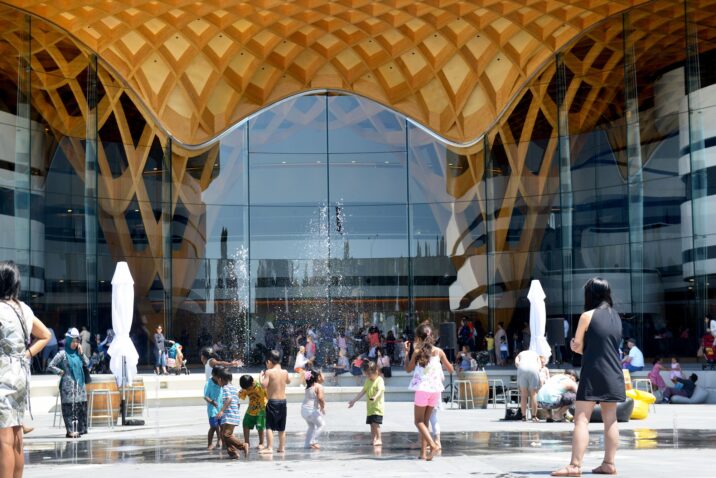
We successfully delivered the Council community zone as part of the broader precinct at Bunjil Place, VIC.
Ultimately, precincts only succeed when people choose to use and love them. Human-centric design — including walkability, public space, housing choice and community amenities — plays a vital role in creating places that support wellbeing and vibrancy. In Docklands, Build-to-Rent is helping reinvigorate the precinct with a stronger residential character, while Queen Victoria Market demonstrates how a precinct can evolve over time and remain deeply loved and well used.
5. Partnering for successful precincts
At RP Infrastructure, we are proud to partner with our clients on property and infrastructure projects across the full lifecycle — supporting projects of all sizes, anywhere in Australia.
As Australia’s cities continue to grow and change, precincts will play an increasingly important role in shaping how communities live, work and connect. Getting them right requires clarity, collaboration, adaptability and, above all, a focus on people.
If you’re currently shaping a precinct or planning a future project, I’d welcome the opportunity to connect and discuss how we might collaborate. You can email me here