

Australia’s housing crisis has sparked plenty of debate about supply and speed to market. But there’s an issue hiding in plain sight.
Too many projects stall in the dead zone between approval and action. The missing piece is speed to site – how quickly we can move from planning consent to shovels in the ground.
The must-read of 2025 has been the Productivity Commission’s report, This diagnoses the systemic causes of the housing affordability crisis: fragmented regulation, slow and complex approvals, skills shortages, and under-resourced councils and agencies.
The Productivity Commission’s focus is policy reform, and the implicit message is: “Governments need to fix this.”
At RP Infrastructure, we are focused on what can be done right now, project by project. From hard-won experience we know most delays are predictable – and yet teams continue to make the same mistakes.
It’s these hidden delays that cause the “cascading failures” the Commission talks about: a missing power connection, a lagging water approval, an overlooked consent condition, or an issue with neighbours. Each can push construction back by months. Sites sit empty and everyone wonders why the project is not progressing.
The hidden bottleneck
A development approval isn’t the finish line. It’s the halfway mark.
After planning consent comes a complex round of engagement with service authorities – electricity, water, sewer, stormwater, fire, transport and environmental regulators. Add to that a plethora of consent conditions that must be closed out before a construction certificate can be issued.
This is the point where projects often stall. Instead of starting demolition or excavation, builders wait for service authorities to sign off or neighbours to be consulted. Time drags on and costs climb.
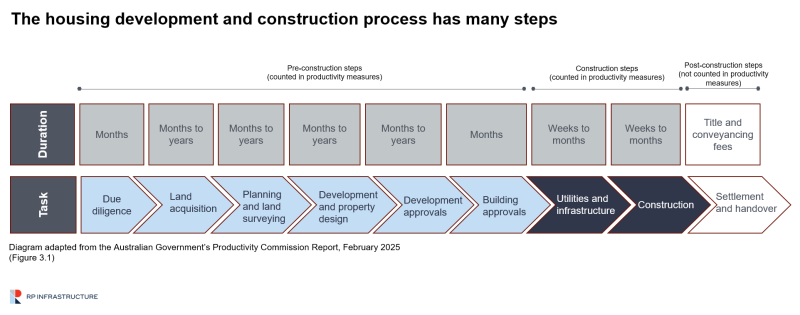
The Productivity Commission’s map of the full journey from land acquisition through to construction is instructive. What’s striking is how long projects spend in the “pre-construction” phase – months or even years before a shovel hits the ground.
For us, the critical pain point is the utilities and in-ground infrastructure phase. It comes late in the sequence, but in practice it’s where projects often get stalled.
When this happens, who is responsible for the risk? Too often, everyone assumes the contractor is responsible for approvals – when in fact the obligation may sit with the client. Blurred accountability creates even more delays and disputes. A trickle of delays turns into a torrent.
How to fix it now
The fix isn’t complicated, but it requires detailed, disciplined work:
- Engage early with service authorities. Identify and build relationships with the decision makers.
- Map responsibilities clearly in planning matrices so risks don’t bounce between client and contractor.
- Start site logistics, staging and demolition planning before the contract clock starts.
- Choose consultants who can challenge assumptions and unlock savings.
- Temperature check the construction market to choose the correct procurement route.
- If ECI into D+C is the chosen procurement route, resolve the terms and conditions of the building contract prior to commencement of the ECI.
This isn’t radical in theory. But it is radical in practice, because too often these steps are overlooked.
From bottleneck to breakthrough
Delays don’t just frustrate project teams; they hit the hip pocket.
Ensuring speed to site does more than accelerate the delivery of homes, it shortens the debt-carrying period, reduces builder risk premiums, and brings forward income. The bottom line? Systemic reform will take time. But we can use the skills and knowledge we already have to bring projects to site sooner and deliver more affordable homes to Australians.
Gideon is a highly experience Associate Director with RP Infrastructure, bringing over 14 years’ experience in major building projects in complex CBD environments.